Guide
Why your state's numbers aren't your neighbor's
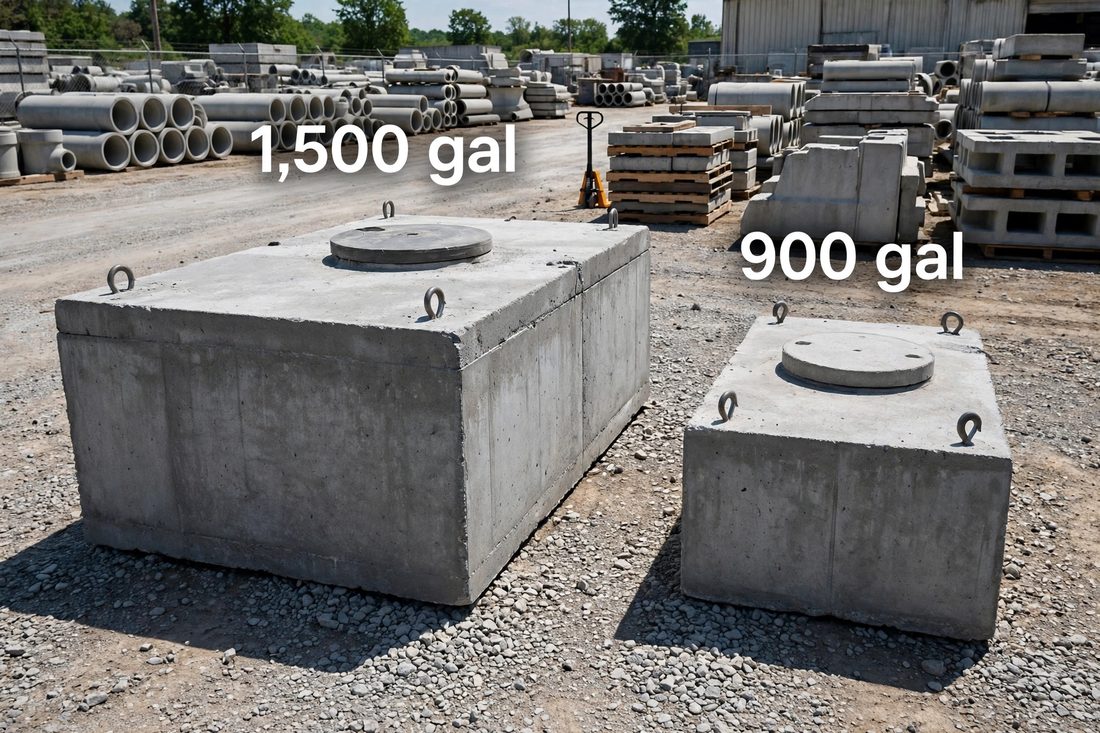
Price a septic tank near a state line and you'll hear two different 'minimums' for the same house — both legal, both correct. A 3-bedroom home needs 900 gallons in Virginia, 1,000 in North Carolina, and 1,500 in Ohio. The rules differ because the rule-writers solved different problems with different math.
Five states, five kinds of math
Plain tables (Ohio, New York, Virginia, Georgia, North Carolina): bedrooms in, gallons out. Simple — until you notice Ohio's table starts 500 gallons above Virginia's. Flow sizing (Texas): the rule never mentions a tank table for homes at all; it assigns your house a daily wastewater flow and sizes the tank from that, which is why Texas answers change with your fixtures. Bedrooms × area (Florida): the only state in our first ten that asks how big the house is, not just how many bedrooms it has. A formula (Pennsylvania): no table exists; a flow quota goes into an equation. County rule (Michigan): the state hands the whole question to 45 health departments, and two adjacent counties can differ by 250 gallons.
And then your county gets a vote
State minimums are floors. The permit is issued locally, and counties can — and do — require more: bigger tanks near lakes, engineered fields on tight soils, extra inspections. In Michigan the county number is the only number. The order of operations that keeps you legal: get the state floor from our calculator, then call the county health department and ask one question — "Do you require anything above the state minimum for a [bedrooms]-bedroom home?" — before you order anything.
Why copied charts fail at state lines
A single national table has to pick one number per bedroom count, so it quietly picks the most common one and presents it as universal. That is how a Virginia homeowner ends up quoted 1,000 gallons for a 750-gallon state, and an Ohio homeowner gets sold a tank 500 gallons under the legal minimum. The state pages here exist to end that: pick your state and read its own rule.
Checked against the state rules cited on our state pages, Nov 10, 2026.